

Imagine you’ve just opened a quaint coffee shop. You put your heart into every brew. But at the end of the month, you wonder if your passion is making money. That’s where an income statement comes in.
This important document shows our business’s money flow. It tells us about our earnings, costs, and profits or losses. As we explore income statements, we’ll see how they help us understand our business better.
Knowing how our statement of earnings works is key. It shows us our financial health and helps us make smart choices. An income statement can point out ways to grow and save money. Let’s learn together about the important parts of income statements.
Key Takeaways
- An income statement summarizes a company’s financial performance over a defined period.
- Revenues serve as the cornerstone for calculating net income.
- Expenses, both fixed and variable, significantly influence our profitability.
- Understanding the role of COGS is critical for assessing a company’s efficiency.
- Net income indicates overall profitability and business health.
- Income statements reveal trends that are key to strategic decision-making.
What is an Income Statement?
An income statement is a key financial document. It shows a company’s income and expenses over a set time, like a month or year. It’s very important because it helps people understand how well a business is doing.
Knowing what an income statement is helps us see how profitable a business is. This is key for checking how well a business is doing.
A Simple Definition
An income statement shows income minus expenses during a certain time. It gives a quick look at profits and losses. This helps us see how our business is doing now and over time.
Looking at an income statement tells us about current profits and future trends. This is very useful for planning ahead.
Why Income Statements Matter
Income statements are very important. They help many people, like investors, creditors, and managers. Investors use them to decide if they should invest in a company.
Managers use them to make smart decisions about their business. Creditors look at them to see if a business can pay back loans.
| Aspect | Description |
|---|---|
| Income Generation | Revenue from operating and non-operating activities. |
| Expenses | Costs incurred related to revenue generation. |
| Net Income | Profit remaining after all expenses are deducted. |
| Trend Analysis | Evaluation of profitability trends over multiple periods. |
| Stakeholders | Investors, Management, Creditors. |
The Purpose of an Income Statement
The income statement is key for knowing if a company is doing well financially. It shows how a business did over a certain time. We can see if it made money, how much it made, and if it spent too much.
This helps businesses make smart money choices. They can see if they are healthy financially.
Tracking Profitability
Every business must check if it’s making money. Income statements help by showing income and expenses. By looking at these statements, we can see which things make the most money.
The formula for net income is simple. It shows how much money we made or lost. This helps us see how we did financially.
Understanding Business Performance
Looking deeper into income statements gives us more info. We learn about how well the business is doing and trends in money. Income statements help us compare things like how much profit we made compared to sales.
This helps us improve and grow. We can see how we did before and try to do better.
| Description | Importance |
|---|---|
| Net Income | Indicates overall profitability after expenses and taxes are deducted. |
| Gross Profit | Shows sales revenue left after cost of goods sold, reflecting operational efficiency. |
| Revenue | Represents total income generated, critical for understanding sales performance. |
| Expenses | Highlights costs incurred in operations, essential for controlling spending. |
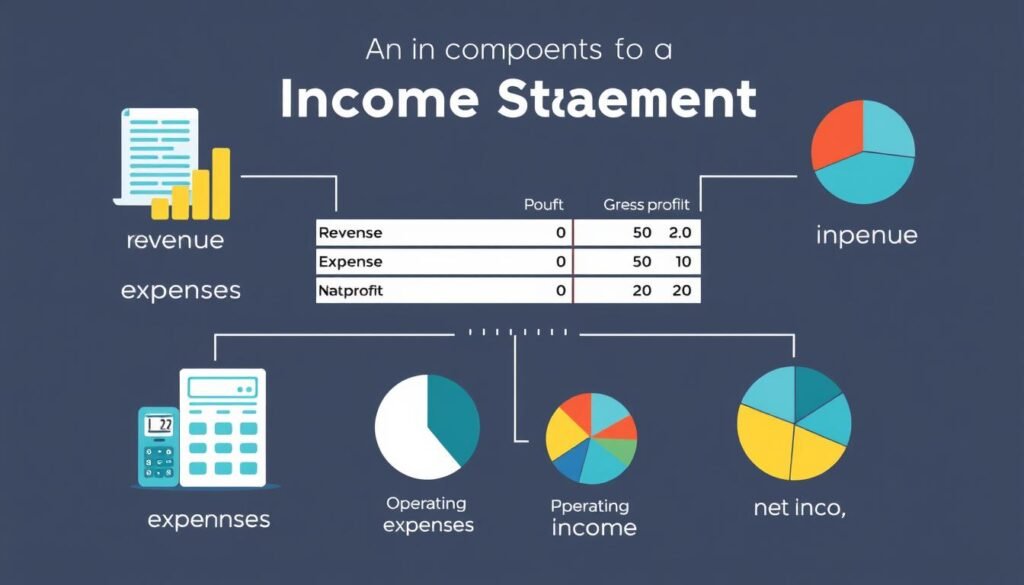
Key Components of an Income Statement
An income statement shows a company’s financial health. It looks at revenue, expenses, and net income. This helps us see how well a business is doing over time.
Revenue: The Starting Point
Revenue is the money a company makes from its main activities. It’s split into two parts: operational and non-operational. Operational revenue comes from selling goods or services. Non-operational revenue is from selling assets or interest on investments.
Focus on growing operational revenue. This helps a business stay stable and succeed in the long run.
Expenses: What’s Going Out
Expenses are the costs to make revenue. They’re also split into two parts: operational and non-operational. Operational expenses are direct costs like salaries and marketing. Non-operational expenses are interest on debt and losses from asset sales.
This way, businesses can better manage their money and control spending.
Net Income: The Bottom Line
Net income is what’s left after subtracting expenses from revenue. It shows if a company is making money. If it’s positive, the company is doing well. If it’s negative, there might be financial problems.
Looking at net income helps with budgeting and understanding trends. By checking these parts of the income statement, we learn about a business’s health and efficiency.
Revenue Explained
Understanding revenue is key to knowing a business’s financial health. Revenue is the total money made from main business activities and some extra ones. By looking at different types of revenue, we can see how they affect profits. This part talks about the types of revenue and how to record them accurately.
Different Types of Revenue
Revenue falls into two main types:
- Operating Revenue: This is money made from the main work of a business, like selling things or services. For example, Microsoft made $245.1 billion in the year ending June 30, 2023. Most of this came from selling software and cloud services.
- Non-Operating Revenue: This is money made from things not directly related to the main business. It could be from interest or selling long-term assets.
How Revenue is Recorded
Recording revenue follows a set rule. Money is counted as income when the service is done or the goods are given, even if the payment comes later. This keeps our financial records up to date and accurate.
Using the right ways to record revenue helps us see the difference between main and extra income. A clear income statement is important for checking how well a business is doing, following rules, and making big decisions.
What Are Expenses?
Understanding expenses is key for good money management. Expenses are the costs we pay to make money. They come in two main types: fixed and variable. Knowing this helps us plan better and make smart business choices.
Fixed vs. Variable Expenses
Fixed expenses don’t change, no matter how much we make. Examples are rent, salaries, and insurance. On the other hand, variable expenses do change. For example, the cost of materials and utility bills go up or down with how much we make.
Examples of Common Expenses
Let’s look at some common expenses and how they affect a business:
| Expense Type | Description | Fixed vs Variable |
|---|---|---|
| Rent | Monthly payment for business premises | Fixed |
| Salaries | Compensation for employees | Fixed |
| Utilities | Electricity, water, and gas costs | Variable |
| Raw Materials | Materials used in production | Variable |
| Marketing | Advertising and promotional expenses | Variable |
By keeping an eye on these expenses, we can manage our money better. This helps us use our resources wisely and stay profitable.
Understanding Operating Income
Operating income shows how well a company does from its main work. It’s like the profit before we add in things like interest and taxes. This helps us see how good a company is at making money from its main activities.
What Operating Income Means
It shows a company’s real health by looking at its main profit. It helps us see how well a company does without outside factors. For example, Apple Inc. made $23.076 billion in operating income last quarter. But, this was less than the $24.126 billion from the year before because of higher costs.
How to Calculate Operating Income
To find operating income, we can use different ways. Here are a few:
- Operating income = Total Revenue – Direct Costs – Indirect Costs
- Operating income = Gross Profit – Operating Expenses – Depreciation – Amortization
- Operating income = Net Earnings + Interest Expense + Taxes
Let’s say we look at D Trump footwear company. With $25 million in sales and $16 million in direct costs, they made $9 million in operating income. This shows they can turn their direct costs into profit while keeping expenses low.
| Company | Total Revenue | Direct Costs | Operating Income |
|---|---|---|---|
| Apple Inc. | $82.959 billion | $59.883 billion | $23.076 billion |
| D Trump Footwear | $25 million | $16 million | $9 million |

Non-Operating Income Explained
Understanding non-operating income helps us see how well a company is doing. It includes money made from things not directly related to the company’s main work. This can change how we see a company’s success.
What Counts as Non-Operating Income?
Non-operating income can be different things. It often includes:
- Dividend income
- Profits or losses from investments
- Foreign exchange gains or losses
- Gains from selling assets or writing them down
For example, if a store invests $10,000 and makes 5%, that’s $500 extra. A big tech company might sell a part for $400 million. This could make their yearly income 40% more if they make $1 billion.
Why It Matters
Non-operating income is very important. It can make a company look better, but we should be careful. A big jump in income might hide problems in the company’s main work.
Investors need to know the difference between operating and non-operating income. Looking at both helps us understand how well a company is really doing. This is important because earnings before interest and taxes (EBIT) might include non-operating income too.
The Role of Cost of Goods Sold (COGS)
Knowing about COGS is key for business owners. COGS includes all direct costs for making goods or services. This includes materials, labor, and overheads.
Defining COGS
COGS is a big part of the income statement. It comes right after sales. It has both variable and fixed costs.
Variable costs are things like raw materials and labor. Fixed costs are things like overhead and depreciation. But, indirect costs like salaries and marketing are not COGS.
How COGS Affects Profit
COGS greatly affects profit. A higher COGS means lower profit margins. This changes how profitable a business looks.
For example, prices can change, affecting net income. The way we value inventory, like FIFO or LIFO, also matters. LIFO can make COGS higher, lowering profits. FIFO can make COGS lower, raising profits.
Here’s a table showing how different methods affect COGS:
| Method | COGS Calculation | Impact During Inflation |
|---|---|---|
| FIFO | First in, first out (older costs used first) | Lower COGS, higher profits |
| LIFO | Last in, first out (newer costs used first) | Higher COGS, lower profits |
| Weighted Average | Total cost of goods available for sale divided by units sold | Moderate COGS |
| Specific Identification | Directly assigns costs to identifiable inventory | Varies by inventory |
Service companies don’t have COGS because they don’t sell things. They use “cost of services” instead. Managing COGS well is crucial. It affects profit and financial health.
Getting COGS right helps avoid problems like fake inventory values. This can mess up profit margins.
Gross Profit: What Is It?
Knowing what gross profit is key to checking a company’s health. It’s what’s left after we subtract the Cost of Goods Sold (COGS) from revenue. This shows how good our business is at making money.
How to Calculate Gross Profit
It’s easy to figure out gross profit. Just use this formula:
Gross Profit = Net Sales – Cost of Goods Sold (COGS)
Let’s say ABC Company made $151.8 billion in sales and spent $126.584 billion on COGS. Their gross profit is $25.216 billion. This means their gross profit margin is about 16.61%.
Gross Profit Margin = (Revenue – COGS) / Revenue x 100
Most businesses have gross profit margins between 20% and 40%. But, this can change a lot depending on the industry.
Why Gross Profit is Important
Gross profit is more than just a number. It helps us understand how well our business is doing. By looking at gross profit, we can find ways to save money and make our products better.
But, we have to watch out. Sometimes, higher gross profits can mean lower margins. This can make our financial picture look worse than it really is.
In short, gross profit is crucial. It helps us see how our business is doing and guides our decisions.
| Item | Amount ($ billion) |
|---|---|
| Total Revenues | 151.8 |
| Total COGS | 126.584 |
| Gross Profit | 25.216 |
| Gross Profit Margin (%) | 16.61 |

Operating Expenses Uncovered
Knowing about operating expenses is key to understanding a business’s health. These costs are needed to run a business and affect our profits. There are different types of operating expenses, like selling and administrative costs.
Types of Operating Expenses
There are many types of operating expenses we need to watch:
- Administrative expenses, like salaries and office supplies.
- Marketing expenses, for promoting sales and brand.
- Occupancy costs, for rent and utilities of a place.
- Research and development expenses, for new ideas and products.
- Depreciation and amortization, for when assets lose value.
The Impact on Income Statements
Operating expenses affect our net income a lot. They reduce profit, showing how well a business runs. By looking at revenue and expenses, we can see how well a business does financially.
Managing operating expenses well can improve profits. For example, Apple spent $12.08 billion on operations in Q3 2022. Knowing these costs helps us find ways to save money.
| Type of Expense | Description | Common Examples |
|---|---|---|
| Administrative Expenses | Costs for general business work | Salaries, office supplies, utilities |
| Marketing Expenses | Money spent to promote and sell | Advertising, market research |
| Occupancy Costs | Expenses for a physical place | Rent, maintenance, utility bills |
| Research and Development | Money for new products or services | Laboratory costs, testing, prototypes |
| Depreciation and Amortization | Accounting for asset value loss over time | Annual depreciation of equipment |
Understanding Net Income
Net income shows how well a business is doing. It’s found by subtracting all costs from what the business makes. This includes taxes and interest.
Calculating Net Income Step-by-Step
To find net income, we do this:
- Start with total revenue, like $500,000 in sales.
- Then subtract the Cost of Goods Sold (COGS), which is $200,000. This leaves a gross profit of $300,000.
- Next, subtract operating expenses, say $180,000. This gives an operating income of $120,000.
- Finally, add back taxes and interest. With a 13.88% tax on $50,000 taxable income, we get $90,000 as net income.
What Net Income Tells Us
Net income is more than just numbers. It shows if a business is making money and can keep doing so. A net income margin of 18% means the business is good at turning sales into profits.
Also, net income helps figure out earnings per share (EPS). Investors watch this closely to see how well a company is doing. Things like depreciation and non-operating items can affect this. So, knowing net income is key to seeing if a business is doing well now and can grow in the future.
Income Statements and Cash Flow
It’s key to know the difference between an income statement and a cash flow statement. They help us see how well a company is doing. The income statement shows profits, while the cash flow statement shows real money movements.
Difference Between Income and Cash Flow
The income statement vs cash flow statement difference is in what they show. An income statement includes things like depreciation. But a cash flow statement shows real money coming in and going out. This helps us understand how money changes over time.
| Aspect | Income Statement | Cash Flow Statement |
|---|---|---|
| Purpose | Shows profitability | Shows cash movement |
| Main Items | Revenue, Expenses, Net Income | Cash Inflows, Cash Outflows |
| Non-Cash Elements | Includes depreciation | Excludes non-cash transactions |
| Time Frame | Monthly, Quarterly, Annual | Monthly, Quarterly, Annual |
Why Both Matter to Us
We need to understand why income and cash flow are important. Good cash flow means a company can pay for things like rent and salaries. Without enough cash, even profitable companies can struggle. Banks also look at cash flow, not just profits, to see if a company can pay its bills.
By looking at both statements, we get a full picture of a company’s finances. This helps us make better choices.
Common Mistakes to Avoid
Knowing common income statement mistakes helps us understand finances better. When we try to see how profitable a company is, we might miss some costs. This makes the profit look higher than it really is.
We must catch all important costs to avoid mistakes. Also, we should watch out for errors in how we record revenue. These mistakes can make the income statement look wrong and confuse people.
Overlooking Certain Expenses
Businesses sometimes miss certain costs. This can make the profit look better than it is. For example, some companies mix up cash and investments with things they can use right now.
It’s important to sort expenses correctly. This way, we know what’s really going on. We should make sure gifts that can’t be used right away are shown correctly.
Misunderstanding Revenue Recognition
Problems with how we recognize revenue can cause big mistakes. Companies might think they can show more money than they really have. If we don’t follow the rules, our profit numbers can be way off.
Learning about revenue recognition is key. It helps us avoid making big mistakes. For more tips on reading income statements, check out this guide.
| Common Income Statement Mistakes | Consequences |
|---|---|
| Overlooking specific expenses | Inflated profit margins and misleading financial assessments |
| Misclassifying revenue recognition timing | Inaccurate portrayal of financial performance |
| Ignoring nonrecurring items | Unreliable net income figures |
| Inaccurate categorization of expenses | Distorted operational insights |
| Failing to follow liquidity ordering | Confused financial position |
Wrapping It Up: Why We Need Income Statements
Income statements are key in making business decisions. They show us how much money a company makes and spends. This helps us see if the company is doing well financially.
We can use this info to plan budgets and check if we’re making money. It helps us find ways to grow or improve. This way, we make smart choices for our business.
Using Income Statements for Decision Making
Income statements help us see how a company is doing over time. They show us the difference between what a company makes and what it spends. This is important for companies like Microsoft.
They help us understand trends. This helps us decide where to invest and how to run our business. Income statements make it easier to see if we’re making money.
Real-Life Business Applications
In the real world, income statements help attract investors. They show a company’s success and growth. This is important for companies to grow and succeed.
By understanding income statements, companies can compare themselves to others. This helps in planning and making smart decisions. Let’s use income statements to help our businesses grow.