

Let’s explore the world of finance together. We often see balance sheets, which are like looking into a cafe. A barista makes each coffee with care, just like a business balances its finances.
This balance shows what the company owns, owes, and what’s left for the owners. It’s not just about numbers. It’s about understanding the health of a business, like enjoying our favorite coffee.
By learning about balance sheets, we can better manage our money. It helps us see the big picture of our finances.
Key Takeaways
- Balance sheets provide a comprehensive overview of a company’s financial position.
- Assets are divided into current and non-current categories, impacting evaluations.
- Liabilities include short-term and long-term obligations that must be managed.
- Understanding equity is essential for recognizing owners’ stake in the business.
- The accounting equation: Assets = Liabilities + Equity serves as the foundation of financial analysis.
What is a Balance Sheet?
A balance sheet is a key financial statement. It shows a company’s assets, liabilities, and equity at a certain time. This helps us see if a company is financially strong and has enough money to pay its debts.
Definition of a Balance Sheet
The balance sheet uses the accounting equation: Assets = Liabilities + Owners’ Equity. This shows how a company uses money to run its business. It lists what the company owns and owes, and what the owners have invested.
Assets are things like cash and buildings. Liabilities are debts that must be paid back soon or later. Knowing these helps us see if a company can pay its bills.
Why Balance Sheets Are Important
Balance sheets help us make smart choices about money. They give a clear picture of a company’s money situation. This helps investors, lenders, and managers make better decisions.
By looking at these statements, we can see how a company’s money situation changes. We can also use special numbers to check if a company is financially healthy. Balance sheets help us understand how a company has changed over time.
| Financial Component | Description |
|---|---|
| Assets | Resources owned by the company, including current and long-term assets. |
| Liabilities | Obligations of the company, split into current and long-term, that represent what the company owes. |
| Owners’ Equity | The residual interest in the assets after deducting liabilities, indicating the company’s net worth. |
| Current Ratio | A liquidity ratio that measures the ability to cover short-term obligations. |
| Debt Ratio | A measure of leverage, indicating the proportion of total liabilities to total assets. |
| Debt to Equity Ratio | Shows the relative proportion of shareholder’s equity to debt used in financing assets. |
The Three Main Parts of a Balance Sheet
Learning about a balance sheet helps us understand a company’s money health. It has three main parts: assets, liabilities, and equity. Each part gives us important info about a business’s money and how it works.
Understanding Assets
Assets are things of value a company has. They are split into two groups. Current assets can turn into cash in a year. Non-current assets are things like long-term investments or property.
For example, our balance sheet shows $110,000 in current assets. This includes money owed to us ($25,000) and things we’ve paid for but not used yet ($20,000). Non-current assets are $50,000, like important equipment.
Understanding Liabilities
Liabilities are debts a company owes to others. Current liabilities are debts due in a year, totaling $30,000. This includes money we owe to suppliers ($10,000) and salaries we haven’t paid yet ($5,000).
Non-current liabilities are debts that last longer, totaling $70,000. Most of this is from long-term bank loans. Knowing about these debts helps us see the company’s risk and how much debt it has.
Understanding Equity
Equity shows what the owners own after paying off all debts. In our case, equity is $90,000. This includes $80,000 in profits, showing the company is doing well. Equity tells us how much of the company’s value belongs to the owners.
| Component | Total ($) |
|---|---|
| Current Assets | 110,000 |
| Non-Current Assets | 50,000 |
| Total Assets | 160,000 |
| Current Liabilities | 30,000 |
| Non-Current Liabilities | 70,000 |
| Total Liabilities | 100,000 |
| Total Equity | 90,000 |
Getting to Know Assets
Assets are key to knowing how well a company is doing. They are things a business owns that help it make money later. We divide assets into two groups: current and non-current. Each group helps a company stay liquid and run smoothly.
What Are Assets?
Assets are things a business owns that can be sold for cash or make money. They help a business grow and stay strong. We look at both current and non-current assets to understand a company’s worth.
Types of Assets: Current vs. Non-Current
Assets are split into two kinds:
- Current Assets: These can be turned into cash or used up in a year or less. Examples are cash, money owed to the business, and things to sell.
- Non-Current Assets: These last more than a year. They include big things like buildings and special rights like patents.
Knowing the difference between these types is important. It shows how well a company can pay its bills on time.
Examples of Assets
Here are some examples of each:
| Type of Asset | Examples |
|---|---|
| Current Assets |
|
| Non-Current Assets |
|
Understanding Liabilities
Liabilities are important parts of a balance sheet. They show what a company owes or debts it has. We split them into two groups: Current Liabilities and Long-Term Liabilities. Knowing these helps us see if a company is financially stable and works well.
What Are Liabilities?
Liabilities are debts a business must pay. They come from borrowing money or other financial deals. Managing Current and Long-Term Liabilities well keeps a company liquid and solvent.
Types of Liabilities: Current vs. Long-Term
We sort liabilities by when they must be paid:
- Current Liabilities are debts due in a year. They include things like bills to pay and short loans. For example, Acme Manufacturing owes $280,800, which is 50.3% of its debts.
- Long-Term Liabilities are debts that last more than a year. They affect a company’s long-term plans. Acme Manufacturing owes $278,000, which is 49.7% of its debts.
Examples of Liabilities
Let’s look at some real examples:
| Type of Liability | Amount | Percentage of Total Liabilities |
|---|---|---|
| Current Liabilities | $280,800 | 50.3% |
| Long-Term Liabilities | $278,000 | 49.7% |
For Acme Manufacturing, liabilities make up 32.4% of its assets. This shows how the company’s finances are set up. Watching both Current and Long-Term Liabilities helps us see if a company can pay its debts and how risky it is to invest.
Exploring Equity
Equity is key in financial statements. It shows a company’s health. It’s what’s left after subtracting liabilities from assets. This shows who owns the business.
This part explains what equity is. It talks about ownership and why it’s important. It shows a company’s value.
What is Equity?
Equity is like a stake in a business. It shows the net value of a company. It’s found by subtracting liabilities from assets.
This shows the financial health of a company. It tells us what shareholders really own.
How Equity Represents Ownership
Equity shows what shareholders own in a company. It includes common stock, preferred stock, and more. It changes with asset values.
This shows how well a company is doing. It shows growth.
The Importance of Equity
Equity is important for understanding a company. It shows financial health and growth potential. It protects against losses.
| Item | Value |
|---|---|
| Total Assets | $60,173 |
| Current Assets | $37,232 |
| Noncurrent Assets | $22,941 |
| Total Liabilities | $16,338 |
| Current Liabilities | $14,010 |
| Noncurrent Liabilities | $2,328 |
| Retained Earnings | $45,528 |
How Assets, Liabilities, and Equity Relate
Assets, liabilities, and equity are connected in our finances. They are tied together by the Accounting Equation. This equation shows that our assets are equal to our liabilities and equity combined. Understanding this helps us see how well a business is doing.
The Accounting Equation
The Accounting Equation is simple: Assets = Liabilities + Equity. It shows the balance in our financial statements. Let’s say a company starts with $30,000 in assets and no liabilities. Its equity is also $30,000.
If the company buys $4,000 in equipment, assets go up but equity stays the same. But, if it gets a $10,000 bank loan, assets increase to $36,000. Liabilities go up to $10,000, but equity stays at $30,000. This shows how our finances are always changing.
A Simple Example
Let’s use an example to make the Accounting Equation clearer. A company starts with:
| Category | Amount |
|---|---|
| Assets | $30,000 |
| Liabilities | $0 |
| Equity | $30,000 |
Then, after buying MacBooks for $4,000, the numbers change:
| Category | Amount |
|---|---|
| Assets | $34,000 |
| Liabilities | $0 |
| Equity | $30,000 |
After getting a loan, the numbers look like this:
| Category | Amount |
|---|---|
| Assets | $36,000 |
| Liabilities | $10,000 |
| Equity | $30,000 |
Finally, if we invest in more equipment for $10,000, the numbers stay the same:
| Category | Amount |
|---|---|
| Assets | $36,000 |
| Liabilities | $10,000 |
| Equity | $30,000 |
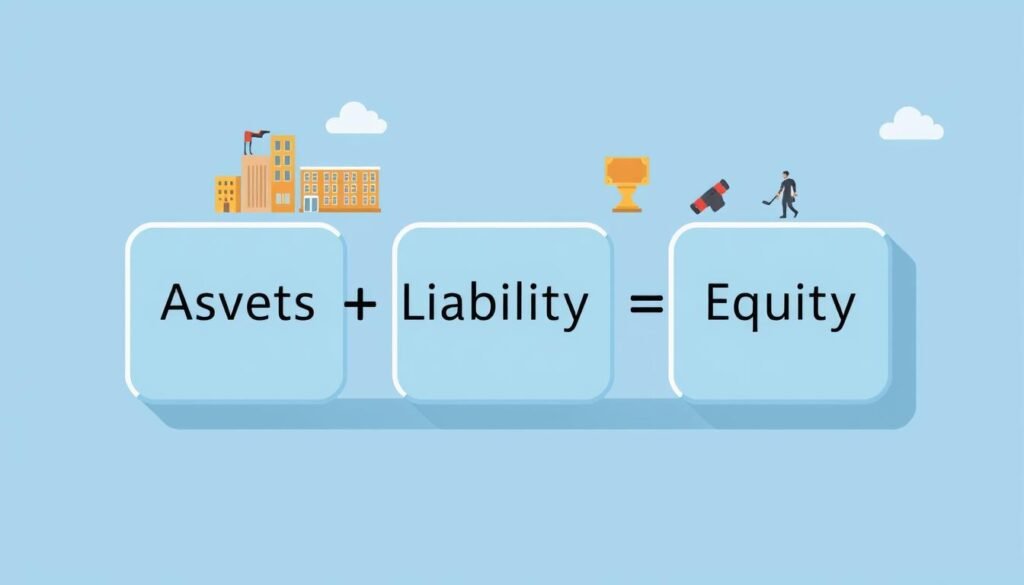
This example shows how the Accounting Equation keeps everything balanced. It helps us understand our finances better. It shows the value of each part and how they change as we make financial choices.
Current Assets: What’s Inside?
Current assets are key to knowing if a company is financially healthy. They help us manage money right away. This is important for daily operations.
These assets can turn into cash or be used up in one year. This helps keep our cash flow strong.
Cash and Cash Equivalents
Cash is the most liquid asset. It includes money and things like money market funds. This helps our working capital stay strong.
Inventory and Accounts Receivable
Inventory and accounts receivable are next. Inventory is the goods we sell. It has a medium liquidity level.
Keeping an eye on inventory helps our supply chain. It makes sure we meet market demand.
Accounts receivable is money owed to us by customers. It has a high liquidity level. Quick collection is key for cash flow.
| Current Asset | Liquidity Level | Description |
|---|---|---|
| Cash | Highest | Immediate currency for operations. |
| Accounts Receivable | High | Amounts due from customers. |
| Inventory | Medium | Goods available for sale. |
| Prepaid Expenses | Low | Payments made for future expenses. |
Long-Term Assets: A Closer Look
Understanding long-term assets is key for our money plans. These assets help us grow and work better. We have two main types: property, plant, and equipment (PP&E), and intangible assets.
Each type has its own role and benefits. They help keep our finances strong.
Property, Plant, and Equipment
PP&E are things we can touch that help us make things and serve people. They last for many years. Examples are:
- Buildings
- Vehicles
- Machinery
- Improvements made to leased property
Knowing the value of our PP&E helps us work better. It helps us decide how to spend money wisely. Keeping these assets in good shape is important.
Intangible Assets
Intangible assets are not physical but are very valuable. They include:
- Patents
- Trademarks
- Licenses
- Goodwill from acquisitions
Handling our intangible assets well is important. They might not be easy to see on a balance sheet. But, they can help us stand out in the market.
In summary, knowing about long-term assets helps us plan better. By understanding PP&E and intangible assets, we can grow and stay strong financially.
Current Liabilities: Short-Term Obligations
It’s key to know about current liabilities to see a business’s short-term money issues. These are debts that must be paid in a year or during a usual business cycle. Accounts payable is often a big part of a company’s financial reports. Short-term debt, like loans to be paid back in a year, is also important.
By watching these current liabilities, businesses can handle their money better. This helps them stay out of financial trouble.
Accounts Payable
Accounts payable is what a company owes its suppliers for buying things on credit. It’s common in many businesses, with payment times from 30 to 90 days. For example, a company might get 60 days to pay its suppliers but need customers to pay in 30 days.
Keeping an eye on accounts payable is crucial. It helps a business stay financially strong. This ensures we pay our suppliers on time and manage our money well.
Short-Term Debt
Short-term debt includes all debts due in a year, like lines of credit and short-term loans. Macy’s Inc. had $6 million in short-term debt, showing they can handle it. It’s important to watch both short-term debt and accounts payable to keep money flowing.
Using the current ratio helps us see if we can meet these short-term payments. It compares current assets to current liabilities.
Long-Term Liabilities: What to Expect
Knowing about long-term liabilities is key for any business. These debts last more than a year and affect a company’s future. Bonds payable and mortgages are big parts of these debts, helping fund big expenses and investments.
Bonds Payable
Bonds payable are a big way for companies to borrow money. When a company issues bonds, it gets money from investors. It promises to pay back the money with interest over time.
This way of getting money lets companies raise a lot of capital without losing equity right away. Bonds have set times to be paid back, which helps predict future money flows.
Mortgages and Long-Term Loans
Mortgages are loans for big things like real estate. They help companies get the things they need for work and growth. Long-term loans are like mortgages but for other big purchases or projects.
Understanding bonds payable and mortgages helps with better financial planning. It helps manage resources better.
| Type of Liability | Total Amount | Percentage of Total Liabilities |
|---|---|---|
| Current Liabilities | $51,127,000 | Approximately 17.6% |
| Long-Term Liabilities | $127,854,000 | Approximately 82.4% |
| Total Liabilities | $289,618,000 | 100% |
Knowing about long-term liabilities helps us plan better. It’s important to keep an eye on these debts to stay financially strong. For more info, check out long-term liabilities on Investopedia.
Putting It All Together: A Sample Balance Sheet
Learning about balance sheets is key for anyone in finance. We’ll make a Sample Balance Sheet for a fake business. This will help us understand how to analyze it well. Let’s start making our balance sheet step by step.
Creating Our Balance Sheet
To make a Sample Balance Sheet, we need to list all assets, liabilities, and equity. Our example is “Where’s the Beef,” a vegan catering business. Here are the numbers we’ll use:
- Total Assets: $9,050
- Checking Account: $2,050
- Accounts Receivable: $6,100
- Equipment: $900
- Total Liabilities: $2,150
- Accounts Payable: $150
- Long-term Debt: $2,000
- Total Equity: $6,900
- Capital: $5,000
- Retained Earnings: $10,900
- Drawings: -$9,000
| Account | Amount ($) |
|---|---|
| Checking Account | 2,050 |
| Accounts Receivable | 6,100 |
| Equipment | 900 |
| Accounts Payable | 150 |
| Long-term Debt | 2,000 |
| Capital | 5,000 |
| Retained Earnings | 10,900 |
| Drawings | -9,000 |
Analyzing Our Balance Sheet
In our Sample Balance Sheet, we use the accounting equation: Assets = Liabilities + Owner’s Equity. For “Where’s the Beef,” we see $9,050 in assets equals $2,150 in liabilities and $6,900 in equity. This shows good financial management.
By analyzing our balance sheet, we check if the business is liquid and solvent. The current ratio is key. A good ratio of at least 2:1 means the business can cover its short-term debts. This makes our balance sheet reliable and helps us track growth.
Reading a Balance Sheet: Step-by-Step
Learning to read a balance sheet is key to knowing a company’s financial health. It has three main parts: assets, liabilities, and equity. These parts help us see if a company is stable and strong.
Identifying Each Section
The main parts of a balance sheet are:
- Assets: These are things the company owns. They can be used up in a year or last longer.
- Liabilities: These are debts the company owes. Some debts need to be paid in a year, others don’t.
- Equity: This shows who owns the company. It tells us how much money comes from shareholders and creditors.
Understanding What to Look For
When we read balance sheets, we look at important numbers. These numbers tell us how well a company is doing.
- Current Ratio: This shows if a company can pay its short-term debts. A ratio of 3.27 means the company has enough money to cover its debts.
- Quick Ratio: This shows if a company can pay its debts right away. A ratio of 2.18 means the company is very liquid.
- Debt-to-Equity Ratio: This shows how much debt a company has. A ratio of 0.4 means the company has 40 cents of debt for every dollar of equity.
- Gross Profit Margin: This shows how much money a company makes after costs. A margin of 55% means the company keeps 55 cents from every dollar.
- Working Capital: This shows if a company has enough money for the short term. It’s current assets minus current liabilities.
By looking at these numbers, we can make better choices. We can understand a company’s financial health better. Knowing how to read a balance sheet helps us make smart decisions about investments and business growth.
Common Mistakes to Avoid with Balance Sheets
We often make mistakes with balance sheets. Knowing these helps us keep our finances accurate and clear. Misclassifying financials can cause big misunderstandings about a company’s success. Also, ignoring changes over time makes it hard to adapt to new financial situations.
Misclassifying Assets and Liabilities
About 40% of small businesses make the mistake of misclassifying assets and liabilities. This mistake makes our financial health look wrong. It can change how we see important financial numbers and make bad choices.
For example, if we don’t count current liabilities right, we might think we have more money than we do. The balance sheet equation, Assets = Liabilities + Shareholders’ Equity, must be correct to really know if we’re financially stable.
Ignoring Changes Over Time
Another big mistake is ignoring changes in our financial statements over time. It’s important to keep checking them. Changes in current assets, liabilities, and equity can change how we see our finances.
We should update and check our financial records often. Companies that do annual balance sheet checks often see big improvements. Studies show these checks can cut down errors by up to 30%. By noticing these changes, we can understand our finances better and get ready for surprises.
| Mistake | Impact | Solution |
|---|---|---|
| Misclassifying assets/liabilities | Inaccurate financial ratios | Regular audits and reviews |
| Ignoring long-term trends | Misleading assessments | Periodic analysis of multiple periods |
| Overlooking non-current assets | Incomplete financial picture | Comprehensive asset valuation |
| Neglecting depreciation | Inflated asset values | Include depreciation in assessments |
By avoiding these common mistakes, we can do better with our finances. Accurate records help us make smart choices that help our business grow.
For more tips on handling balance sheets well, check out this resource.
Tips for Creating Your Own Balance Sheet
Making a balance sheet might seem hard at first. But, with some easy tips, it gets simpler. It’s key to keep it clear and easy to use. Regular checks help keep our money info right, helping us make smart choices.
Keeping it Simple
Starting with a simple plan is best when we make balance sheets. It has three main parts: assets, liabilities, and equity. Here’s how to set it up easily:
- Assets: List what you own now and what you’ll own later.
- Liabilities: Note what you owe now and what you’ll owe later.
- Equity: Find out how much the owners own and what’s left over.
Regular Updates and Reviews
Keeping our money info up to date is crucial. We should update our balance sheets every three months. Bigger companies might do it every month. Startups might get by with quarterly updates. Here are some Financial Management Tips:
- Use tools like QuickBooks or Xero to make it easier.
- Check important money info like profits and what you owe.
- Make sure you know the difference between what you can use now and what you’ll use later.
| Section | Description |
|---|---|
| Assets | Things you own, split into what you can use now and what you’ll use later. |
| Liabilities | Things you owe, like debts. |
| Equity | What’s left for the owners after you pay off what you owe. |
Conclusion: Understanding Balance Sheets
Understanding balance sheets is key in accounting. They show a company’s financial health. This includes assets, liabilities, and owner’s equity.
Knowing about assets and liabilities helps us analyze and plan. It’s important for making smart decisions.
Learning about balance sheets boosts our business skills. It helps us see if a company is financially stable. This is crucial for investing and getting loans.
Keeping records up to date is also important. It helps us stay ready for new chances and challenges.
Getting balance sheets means more than just numbers. It’s about learning more about money and business. It helps us understand a company’s health better.
This knowledge is the start of more learning. It prepares us for even more about accounting.